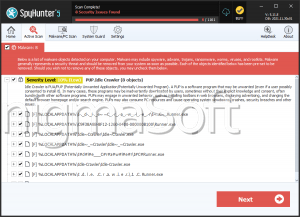
PUP.Crawler
The detection of PUP.Crawler on your system indicates the presence of a potentially unwanted program (PUP) that may be compromising your computer's security and performance. This type of threat is often installed without the user's knowledge or consent, and can lead to a range of problems, from annoying pop-ups and redirects to more serious issues like data theft and system crashes.
Table of Contents
What Is PUP.Crawler?
PUP.Crawler is a type of malware that falls under the category of potentially unwanted programs. These programs are not necessarily malicious in the classical sense, but they can still cause significant disruptions to your system and online activities. PUPs often sneak onto your computer through bundled software downloads, infected email attachments, or exploited vulnerabilities in your operating system or applications.
How PUP.Crawler Operates
Once installed, PUP.Crawler can operate in various ways, depending on its intended purpose. Some common behaviors of PUPs include collecting user data, such as browsing history and search queries, and using this information to display targeted advertisements. They may also modify system settings, hijack browser home pages, or install additional malware and toolbars. In some cases, PUPs can even communicate with remote servers to receive updates or transmit stolen data.
Symptoms of Infection
If your system is infected with PUP.Crawler, you may notice a range of symptoms, including unusual pop-ups, redirects to unfamiliar websites, and changes to your browser settings. You may also experience system crashes, slow performance, or unusual network activity. In some cases, you may not notice any symptoms at all, which is why regular system scans and monitoring are essential for detecting and removing PUPs like PUP.Crawler.
How to Remove PUP.Crawler
- Boot your computer in Safe Mode with Networking to prevent PUP.Crawler from loading and to allow for a more thorough removal process.
- Use a reputable anti-malware tool, such as SpyHunter, to perform a full system scan and detect all instances of PUP.Crawler. Be sure to update the tool to the latest version before scanning.
- Uninstall any suspicious programs or applications that may be related to PUP.Crawler. Check the list of installed programs and look for anything that you don't recognize or that was installed around the time the PUP was detected.
- Reset your web browsers, including Chrome, Firefox, and Edge, to their default settings to remove any modifications made by PUP.Crawler. This will also help to remove any unwanted toolbars or extensions.
- Reboot your computer and perform another full system scan to ensure that PUP.Crawler has been completely removed. This will help to detect any remaining malware or PUPs that may have been installed by PUP.Crawler.
Conclusion
Removing PUP.Crawler from your system requires a combination of technical expertise and caution. By following the steps outlined above and taking proactive measures to protect your system, you can help to prevent future infections and keep your computer running smoothly. Remember to always be vigilant when downloading software, opening email attachments, and clicking on links, as these are common ways for PUPs like PUP.Crawler to spread. Regular system scans and updates can also help to detect and remove PUPs before they cause significant harm. Additionally, consider using a reputable antivirus program and a firewall to provide an extra layer of protection against malware and other online threats.
Analysis Report
General information
| Family Name: | PUP.Crawler |
|---|---|
| Signature status: | No Signature |
Known Samples
Known Samples
This section lists other file samples believed to be associated with this family.|
MD5:
e34112c19107a1e9055ef0f8dce33414
SHA1:
015fd4260612908eab1f496f7294e0cac3fa6b44
SHA256:
A0D5BEF9E1E9DD98A23CF4E44110BCA005FD8AE9004B83223950A1DAC2B3BD81
File Size:
131.58 KB, 131584 bytes
|
|
MD5:
7222891df80c79098aaa3c2f5a374801
SHA1:
28cf7b6dec0ee406dd974f1338106ce9a2448932
SHA256:
CF413F658E32A2D781A95C21825CE82448875D8881BF3ACD3791063DE83A89FC
File Size:
2.01 MB, 2013520 bytes
|
|
MD5:
16aba5a31da0b7374411079c309cabc0
SHA1:
8e8c054b90b71f1ad706909968a0e3de7a1f4311
SHA256:
F28BF7C9CA6218F7D5F69225B93569BA74BBC1CEEDB5D53DAB43F45E0F64A8BC
File Size:
133.63 KB, 133632 bytes
|
|
MD5:
44f78049142b91d5cf7b4dc2c9039289
SHA1:
54f00e710f0a0079b78bb941411fa22bb8e215b4
SHA256:
4538887B57808B3470EC1395F335378A08AB023AEF3AA6956F31A7B065536FF6
File Size:
1.14 MB, 1139712 bytes
|
|
MD5:
d056596408430df5af0b41759edaf652
SHA1:
9b35c3e4ad6647b3d6ed107a6fcf5dd5461e0207
SHA256:
8DE00C88CEF1433FB0B18680CF918BA6B6064D9664E311505DD843B9CA62FD41
File Size:
911.36 KB, 911360 bytes
|
Windows Portable Executable Attributes
- File doesn't have "Rich" header
- File doesn't have debug information
- File doesn't have exports table
- File doesn't have security information
- File has exports table
- File has TLS information
- File is 32-bit executable
- File is 64-bit executable
- File is either console or GUI application
- File is GUI application (IMAGE_SUBSYSTEM_WINDOWS_GUI)
Show More
- File is Native application (NOT .NET application)
- File is not packed
- IMAGE_FILE_DLL is not set inside PE header (Executable)
- IMAGE_FILE_EXECUTABLE_IMAGE is set inside PE header (Executable Image)
File Icons
File Icons
This section displays icon resources found within family samples. Malware often replicates icons commonly associated with legitimate software to mislead users into believing the malware is safe.


Windows PE Version Information
Windows PE Version Information
This section displays values and attributes that have been set in the Windows file version information data structure for samples within this family. To mislead users, malware actors often add fake version information mimicking legitimate software.| Name | Value |
|---|---|
| Company Name |
|
| File Description |
|
| File Version |
|
| Legal Copyright |
|
| Original Filename |
|
| Product Name |
|
| Product Version |
|
Digital Signatures
Digital Signatures
This section lists digital signatures that are attached to samples within this family. When analyzing and verifying digital signatures, it is important to confirm that the signature’s root authority is a well-known and trustworthy entity and that the status of the signature is good. Malware is often signed with non-trustworthy “Self Signed” digital signatures (which can be easily created by a malware author with no verification). Malware may also be signed by legitimate signatures that have an invalid status, and by signatures from questionable root authorities with fake or misleading “Signer” names.| Signer | Root | Status |
|---|---|---|
| Crawler Group, LLC | Crawler Group, LLC | Root Not Trusted |
File Traits
- 2+ executable sections
- dll
- VirtualQueryEx
- x86
Block Information
Block Information
During analysis, EnigmaSoft breaks file samples into logical blocks for classification and comparison with other samples. Blocks can be used to generate malware detection rules and to group file samples into families based on shared source code, functionality and other distinguishing attributes and characteristics. This section lists a summary of this block data, as well as its classification by EnigmaSoft. A visual representation of the block data is also displayed, where available.| Total Blocks: | 2,606 |
|---|---|
| Potentially Malicious Blocks: | 8 |
| Whitelisted Blocks: | 2,321 |
| Unknown Blocks: | 277 |
Visual Map
? - Unknown Block
x - Potentially Malicious Block
Similar Families
Similar Families
This section lists other families that share similarities with this family, based on EnigmaSoft’s analysis. Many malware families are created from the same malware toolkits and use the same packing and encryption techniques but uniquely extend functionality. Similar families may also share source code, attributes, icons, subcomponents, compromised and/or invalid digital signatures, and network characteristics. Researchers leverage these similarities to rapidly and effectively triage file samples and extend malware detection rules.- Danabot.AJ
Windows API Usage
Windows API Usage
This section lists Windows API calls that are used by the samples in this family. Windows API usage analysis is a valuable tool that can help identify malicious activity, such as keylogging, security privilege escalation, data encryption, data exfiltration, interference with antivirus software, and network request manipulation.| Category | API |
|---|---|
| Syscall Use |
Show More
|
| Process Manipulation Evasion |
|
| Process Shell Execute |
|
| Anti Debug |
|
Shell Command Execution
Shell Command Execution
This section lists Windows shell commands that are run by the samples in this family. Windows Shell commands are often leveraged by malware for nefarious purposes and can be used to elevate security privileges, download and launch other malware, exploit vulnerabilities, collect and exfiltrate data, and hide malicious activity.
C:\WINDOWS\SysWOW64\rundll32.exe C:\WINDOWS\system32\rundll32.exe c:\users\user\downloads\8e8c054b90b71f1ad706909968a0e3de7a1f4311_0000133632.,LiQMAxHB
|
C:\WINDOWS\SysWOW64\rundll32.exe C:\WINDOWS\system32\rundll32.exe c:\users\user\downloads\54f00e710f0a0079b78bb941411fa22bb8e215b4_0001139712.,LiQMAxHB
|