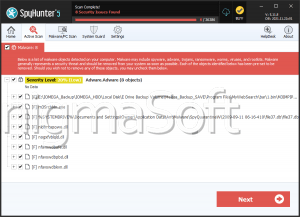
Adware.Fearads
Threat Scorecard
EnigmaSoft Threat Scorecard
EnigmaSoft Threat Scorecards are assessment reports for different malware threats which have been collected and analyzed by our research team. EnigmaSoft Threat Scorecards evaluate and rank threats using several metrics including real-world and potential risk factors, trends, frequency, prevalence, and persistence. EnigmaSoft Threat Scorecards are updated regularly based on our research data and metrics and are useful for a wide range of computer users, from end users seeking solutions to remove malware from their systems to security experts analyzing threats.
EnigmaSoft Threat Scorecards display a variety of useful information, including:
Popularity Rank: The ranking of a particular threat in EnigmaSoft’s Threat Database.
Severity Level: The determined severity level of an object, represented numerically, based on our risk modeling process and research, as explained in our Threat Assessment Criteria.
Infected Computers: The number of confirmed and suspected cases of a particular threat detected on infected computers as reported by SpyHunter.
See also Threat Assessment Criteria.
| Popularity Rank: | 17,451 |
| Threat Level: | 20 % (Normal) |
| Infected Computers: | 713 |
| First Seen: | March 12, 2012 |
| Last Seen: | September 14, 2026 |
| OS(es) Affected: | Windows |
The detection of Adware.Fearads on your system indicates the presence of unwanted software that may be displaying advertisements, collecting data, or performing other potentially unwanted actions. It is essential to address this issue to protect your privacy and maintain the security and performance of your computer.
Table of Contents
What Is Adware.Fearads?
Adware.Fearads is a type of malicious software that is designed to display unwanted advertisements on infected systems. The name itself suggests that it is related to adware, a category of malware that prioritizes generating revenue for its creators by displaying ads, often in intrusive or deceptive ways. Adware can be installed on a system through various means, including bundled software downloads, infected websites, or email attachments.
How Adware.Fearads Operates
Once installed, Adware.Fearads can operate in several ways to achieve its goals. It may display pop-up ads, banners, or other types of advertisements on your computer, often in locations where you least expect them. This adware might also collect data about your browsing habits, search queries, or other online activities to tailor the ads to your interests, making them more appealing and potentially increasing the chances of you clicking on them. Furthermore, Adware.Fearads could potentially redirect your searches or homepage to affiliate websites, further generating revenue for its creators.
Symptoms of Infection
Identifying an Adware.Fearads infection can be challenging, as its symptoms may resemble those of legitimate software or system issues. Common indicators include an increase in unwanted advertisements, slower system performance, unexpected changes to your browser's homepage or search engine, and the appearance of suspicious programs or toolbars in your browser or system. If you notice any of these symptoms, it is crucial to take immediate action to protect your system and personal data.
How to Remove Adware.Fearads
- Boot your computer in Safe Mode with Networking to limit the malware's ability to interfere with the removal process.
- Perform a full scan of your system using a reputable anti-malware tool, such as SpyHunter, to detect and remove all components of Adware.Fearads.
- Uninstall any suspicious programs or applications that you do not recognize or no longer need, as they might be related to the adware infection.
- Reset your web browsers (Chrome, Firefox, Edge, etc.) to their default settings to remove any changes made by the adware, such as altered homepages or search engines.
- Reboot your computer and perform another full scan with your anti-malware tool to ensure that all remnants of Adware.Fearads have been removed.
Conclusion
Removing Adware.Fearads from your system requires careful attention to detail and the use of appropriate tools. By following the steps outlined above and maintaining good computing practices, such as regularly updating your software, using strong antivirus programs, and being cautious with downloads and email attachments, you can protect your system from future infections. Remember, the key to dealing with malware effectively is a combination of awareness, prompt action, and the use of reliable security software.
Analysis Report
General information
| Family Name: | Adware.Fearads |
|---|---|
| Signature status: | No Signature |
Known Samples
Known Samples
This section lists other file samples believed to be associated with this family.|
MD5:
2410ff18cbc063bc2f83fd47deb8ad67
SHA1:
742741806ace131fa27ad68daba8b5f73fb7cb77
SHA256:
7ADA1DFA5A822DBE557D9330C5A7E4835F3A7A9C385E2B9778F929AD300D676F
File Size:
110.59 KB, 110592 bytes
|
|
MD5:
20a808f01a6fed1048ba2c12fd844eb7
SHA1:
fac98e78d37ad64e5793d12ce0a063285bca10f8
SHA256:
5EABE76118798D7A4588014B74FADB63D1AC08A71B7EC90C09C103576C06E4F9
File Size:
1.63 MB, 1634304 bytes
|
Windows Portable Executable Attributes
- File doesn't have "Rich" header
- File doesn't have debug information
- File doesn't have exports table
- File doesn't have relocations information
- File doesn't have security information
- File has exports table
- File has TLS information
- File is 32-bit executable
- File is either console or GUI application
- File is GUI application (IMAGE_SUBSYSTEM_WINDOWS_GUI)
Show More
- File is Native application (NOT .NET application)
- File is not packed
- IMAGE_FILE_DLL is not set inside PE header (Executable)
- IMAGE_FILE_EXECUTABLE_IMAGE is set inside PE header (Executable Image)
File Icons
File Icons
This section displays icon resources found within family samples. Malware often replicates icons commonly associated with legitimate software to mislead users into believing the malware is safe.


Windows PE Version Information
Windows PE Version Information
This section displays values and attributes that have been set in the Windows file version information data structure for samples within this family. To mislead users, malware actors often add fake version information mimicking legitimate software.| Name | Value |
|---|---|
| Company Name | Al-Waseet Computer Services |
| Fax | +966-13-8341549 |
| File Description |
|
| File Version |
|
| Internal Name | DogEncryption |
| Legal Copyright |
|
| Original Filename |
|
| Product Name | DogEncryption Application |
| Product Version |
|
| Tel | +966-13-8300025 |
| Web Site | http://www.al-waseet.com.sa |
File Traits
- 2+ executable sections
- HighEntropy
- VirtualQueryEx
- x86
Block Information
Block Information
During analysis, EnigmaSoft breaks file samples into logical blocks for classification and comparison with other samples. Blocks can be used to generate malware detection rules and to group file samples into families based on shared source code, functionality and other distinguishing attributes and characteristics. This section lists a summary of this block data, as well as its classification by EnigmaSoft. A visual representation of the block data is also displayed, where available.| Total Blocks: | 4,192 |
|---|---|
| Potentially Malicious Blocks: | 0 |
| Whitelisted Blocks: | 4,171 |
| Unknown Blocks: | 21 |
Visual Map
? - Unknown Block
x - Potentially Malicious Block
Similar Families
Similar Families
This section lists other families that share similarities with this family, based on EnigmaSoft’s analysis. Many malware families are created from the same malware toolkits and use the same packing and encryption techniques but uniquely extend functionality. Similar families may also share source code, attributes, icons, subcomponents, compromised and/or invalid digital signatures, and network characteristics. Researchers leverage these similarities to rapidly and effectively triage file samples and extend malware detection rules.- Agent.M
- Banload.Q
- Trojan.Downloader.Gen.ACO
- Trojan.Downloader.Gen.AJQ
- Urelas.F